Crypto Yield Strategies: A Risk-Tiered 2026 Framework
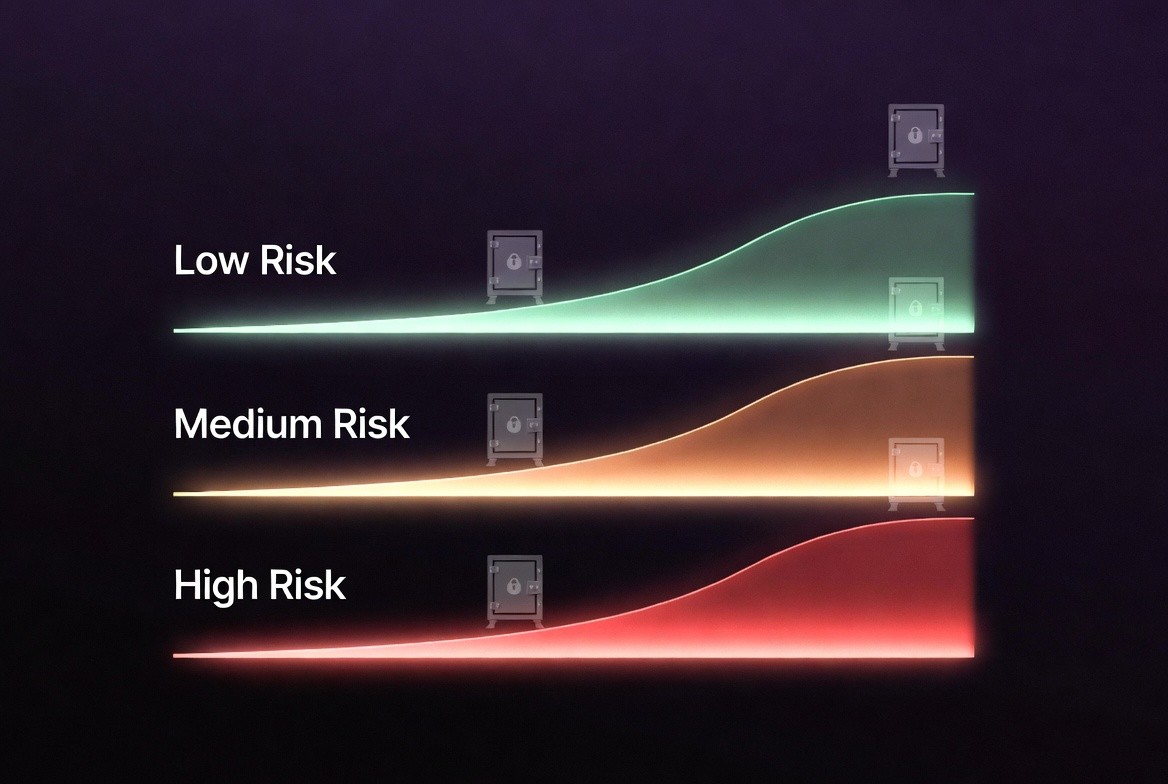
Total DeFi TVL crossed $192 billion in early 2026. That number tells you capital has arrived. But it doesn't tell you where to put yours.
Most guides to crypto yield strategies hand you a list of platforms with APY numbers attached. That's not a strategy; that's a menu. The mechanism behind each yield source determines its sustainability, its exit liquidity, and most critically, where it sits on the risk spectrum. Treat a restaking reward stream the same as a stablecoin lending rate and you'll misprice the risk every time.
This guide maps the major crypto yield strategies into four risk tiers. Each tier explains what drives the yield, what the realistic return range looks like under current market conditions, and what can go wrong. The goal is a framework you can actually use to construct a portfolio allocation, not just a comparison of APYs.
What Actually Generates Yield in Crypto?
Before ranking strategies by risk, it helps to understand the three yield engines that power almost every onchain return. Stablecoin yield analysts at Stablecoin Insider describe the yield market as "a stack of different yield engines, not one average rate," and that framing holds across the broader crypto yield market.
The Three Yield Engines
Borrowing demand is the most structurally sound yield source. Lending protocols charge interest to borrowers; that interest flows to depositors. The rate fluctuates with utilization, meaning how much of the available supply is actually borrowed. When markets are active and borrowing demand is high, lending yields rise. When conditions cool, they compress.
Trading fees power liquidity provision strategies. Every swap on a DEX generates a small fee, split among liquidity providers proportional to their share of the pool. This yield is real and organic, but it's tied to trading volume and to how well your liquidity is positioned within the price range.
Protocol incentives are token emissions distributed to attract capital. They inflate stated APYs but carry a structural ceiling: emissions decline over time as protocols mature or as token prices fall. Strategies built primarily on incentives require active monitoring and reallocation.
Why the Source Matters More Than the APY Number
A 12% APY from lending demand is categorically different from a 12% APY built on token emissions. One depends on market activity that you can model; the other depends on a token price and emission schedule that can change without warning. Before allocating to any strategy, identify which engine is driving the yield and how durable that engine is likely to be.
Tier 1: Base-Layer Staking and Liquid Staking Derivatives
How Liquid Staking Works and What Drives Its Yield
Proof-of-stake blockchains pay validators for securing the network. On Ethereum, this means ETH holders who stake their assets earn a base protocol reward, currently in the range of 3.2–3.8% annually. Liquid staking protocols like Lido wrap this process into a tradeable token (stETH, for example) so you can earn staking yield without locking assets in the validator queue.
Liquid staking functions as the DeFi equivalent of a money-market instrument: predictable, low-volatility yield backed by protocol-level economics rather than speculative demand. Lido currently holds over $38 billion in TVL, making it one of the most widely used yield entry points in DeFi.
What Is the Real Yield From ETH Staking in 2026?
ETH liquid staking yields have stabilized in a narrow band. Base staking rewards sit at roughly 3.2–3.8% depending on network validator count, with some liquid staking protocols layering small additional fees or incentive programs. According to DL News' State of DeFi analysis, liquid staking protocol revenue grew from approximately $10M to $15M monthly over the prior year, though Lido's share of the market has seen gradual erosion from newer entrants.
For most institutional allocators and conservative DeFi participants, this is the floor of the yield stack. It's where you park ETH that needs to remain productive without taking on additional protocol complexity.
Risk Profile: Slashing, Withdrawal Queues, Depeg
Three risks belong on your radar. Slashing occurs when validator nodes behave incorrectly; while rare for major operators, it can reduce principal. Withdrawal queues on Ethereum mean you can't exit staking positions instantly during stress events. And liquid staking tokens like stETH can trade at a slight discount to ETH during market dislocations, introducing short-term basis risk if you need to liquidate quickly.
Tier 2: Onchain Lending Markets
Aave, Morpho, and the Dynamics of Utilization-Driven Yield
Lending markets are the most institutionally legible onchain yield source. You deposit assets into a smart contract pool; borrowers draw from that pool and pay interest. The rate adjusts dynamically based on utilization, typically rising sharply as the pool approaches full utilization to incentivize new deposits and discourage additional borrowing.
Research from Fensory shows that major lending protocols now derive around 65% of yield from genuine borrowing demand rather than token incentives, a meaningful shift toward structural, sustainable yield. Aave and Morpho represent the dominant venues, each with different architecture. Morpho's peer-to-peer matching layer can improve rates for both sides when matched liquidity is available.
What Yields Can You Expect From DeFi Lending?
Stablecoin lending has historically ranged from 4% to 12% on major protocols, depending on market conditions. In quiet periods with low leverage demand, USDC and USDT yields often compress to the 4–6% range. During bull-market periods or when borrowing demand spikes, yields can temporarily exceed 10%.
ETH and BTC lending yields are typically lower than stablecoin rates because borrowing demand for these assets is less consistent. Stablecoin lending is generally the more predictable DeFi yield source within this tier.
Key Risks: Smart Contract Exposure and Utilization Compression
Two risks deserve emphasis. Smart contract risk is the baseline exposure on any DeFi protocol: bugs or exploits can result in permanent capital loss. Major protocols like Aave mitigate this through audits, insurance modules, and years of live deployment, but the risk never fully disappears. Checking protocol security standards before deploying capital is worth the time. Lucidly's secure DeFi yield guide for 2026 covers a practical framework for evaluating protocol security.
Utilization compression is a less obvious risk. When borrowing demand drops, yields fall, sometimes sharply. A 9% APY can quickly become 4% if market conditions shift, disrupting income expectations for allocators who sized positions based on peak rates.
Tier 3: Liquidity Provision and Concentrated AMMs
How LP Fees Generate Yield and Why Impermanent Loss Matters
Liquidity providers deposit two assets into an AMM pool and earn a share of every swap fee generated within that pool. Think of it as operating an automated market-making desk: you earn the spread, but you bear inventory risk when prices move.
That inventory risk manifests as impermanent loss: a reduction in the dollar value of your position relative to simply holding the assets. It's realized when you withdraw and the ratio of assets has shifted from what you deposited. On volatile asset pairs, impermanent loss can significantly erode fee income.
Stable-Pair Pools vs. Volatile-Pair Pools
Stable-pair pools (USDC/USDT, for example) generate lower fees per swap but carry minimal impermanent loss because the assets trade near parity. They're appropriate when capital preservation matters more than yield maximization. For a deeper look at the full range of advanced DeFi yield farming strategies, including how volatile-pair LP positions can be sized effectively, the tradeoffs are covered in detail.
Volatile-pair pools offer higher fee potential but require active management. The impermanent loss profile on a ETH/USDC pool during a 40% ETH price move can be significant, and returns depend heavily on whether fee income outpaces that loss.
CLMMs: Higher Capital Efficiency, Higher Active Management Demand
Concentrated liquidity market makers (CLMMs) allow you to deploy capital within a specific price range, dramatically increasing fee income per dollar of liquidity compared to full-range positions. The tradeoff is active management: when price moves outside your range, your position earns nothing and your exposure shifts entirely to one asset.
A hedged CLMM strategy can capture the fee income while offsetting directional exposure. Lucidly's own experience building a hedged CLMM strategy demonstrates how this structure can generate consistent fee revenue while managing the impermanent loss problem that typically limits LP returns.
Tier 4: Restaking and Structured Yield Products
What Is Restaking and How Does EigenLayer Generate Additional Yield?
Restaking lets you use already-staked ETH to secure additional decentralized services, specifically Actively Validated Services (AVSs) on EigenLayer. Think of it as collateral reuse: your ETH simultaneously backs Ethereum and provides security to other protocols that pay for it.
EigenLayer currently holds over $17.5 billion in TVL, with roughly 30% of all staked ETH now participating in some form of restaking. The additional yield from AVS rewards has historically pushed total returns into the 4–7% range on top of base staking, though this varies significantly based on AVS demand and slashing risk profiles.
The added risk is real. Restaking introduces additional slashing conditions from each AVS you secure. A validator node that behaves incorrectly can be penalized across multiple layers simultaneously. This is not a passive extension of liquid staking; it requires careful selection of which AVSs to support.
Yield Tokenization via Pendle: Fixed-Rate Exposure Onchain
Pendle splits yield-bearing assets into two tokens: a principal token (PT) and a yield token (YT). The PT represents a fixed return to maturity; the YT captures the variable yield component. For allocators who want predictable returns without variable-rate exposure, buying PTs is effectively a fixed-rate bond equivalent onchain.
This is one of the more institutionally useful structures to emerge in DeFi. A treasury that wants 7% fixed for six months on its USDC can access that through Pendle markets without taking on variable utilization risk. Lucidly's integration with Spectra for fixed-rate syUSD reflects a similar approach to structured fixed-rate yield products.
Delta-Neutral Strategies and Funding-Rate Yield
Funding-rate strategies capture the premium paid by perpetual futures traders who hold long positions. By going long on the spot asset and short on the perpetual simultaneously, you collect funding payments while remaining market-neutral. During bull markets, funding rates can reach 20–40% annualized.
The risk is funding-rate reversal: when markets flip bearish, funding can go negative, meaning you pay rather than collect. These strategies work best as tactical allocations during high-funding environments, not as core portfolio positions.
How Should You Allocate Across Yield Strategies?
A Framework for Portfolio Construction Across Tiers
A rational allocation framework treats the four tiers as building blocks, not alternatives. The base layer, liquid staking, provides consistent, low-complexity yield that forms the anchor of most onchain portfolios. Lending markets add yield on top of that with manageable protocol risk. LP strategies and structured products come next for allocators with higher risk tolerance and operational capacity.
A conservative institutional allocation might look like this: 50–60% in liquid staking and lending, 20–30% in stable-pair LP strategies, and 10–20% in structured products like fixed-rate yield or delta-neutral positions. Aggressive yield farmers might weight the LP and structured tiers more heavily, accepting higher variance in exchange for higher average yield.
What Yield Strategies Are Best for Institutional Allocators?
Institutional allocators (family offices, DAO treasuries, hedge funds entering DeFi) consistently prioritize two factors: capital preservation and operational simplicity. That means liquid staking and stablecoin lending dominate most institutional portfolios.
Institutional-grade yield frameworks in DeFi increasingly treat stablecoin yield as a substitute for short-duration fixed income: lower risk, liquid, and productively deployed without taking directional crypto exposure. The onchain yield advantage over TradFi equivalents has narrowed as rates have moved, but the gap remains meaningful for allocators willing to manage smart contract risk.
The Role of Automated Vaults in Reducing Operational Overhead
Running multiple yield strategies manually across different protocols is operationally demanding. DeFi vaults automate the compound-and-reallocate cycle, reducing the work required to maintain a diversified onchain yield portfolio. ERC-4626 standardized vaults in particular have made it easier to build multi-strategy allocations without custom integrations for each protocol.
For allocators who want exposure across multiple tiers without the execution overhead, curated vault access provides a meaningful structural advantage.
Putting It Together
Crypto yield strategies in 2026 span a wide risk spectrum, from sub-4% liquid staking at the conservative end to 20%+ structured products at the aggressive end. The key insight is that the mechanism behind the yield matters more than the rate itself.
Build from the base tier up. Anchor the portfolio in structurally sound, demand-driven yield sources. Add LP and restaking exposure proportional to your operational capacity and risk tolerance. Use structured products tactically, not as core positions.
Platforms like Lucidly Finance are designed specifically for allocators who want institutional-grade access across these tiers: curated vaults, transparent risk frameworks, and automated execution without the overhead of managing each strategy manually. The yield is onchain. The framework for capturing it intelligently is what separates consistent returns from market noise.
Frequently Asked Questions
What is the safest crypto yield strategy in 2026? Liquid staking on major protocols like Lido is generally considered the lowest-risk entry point, offering around 3.2–3.8% APY from protocol-level staking rewards with minimal smart contract complexity. Stablecoin lending on established protocols like Aave is the next tier, offering slightly higher yield with slightly higher protocol risk.
How much yield can you realistically earn from DeFi? A diversified portfolio across the four tiers described here can realistically target 6–14% blended yield under current market conditions. Conservative allocations weighted toward staking and lending sit at the lower end; more active LP and structured strategies can push toward the higher range, with correspondingly higher variance.
What is restaking in crypto? Restaking allows already-staked ETH to simultaneously secure additional protocols beyond Ethereum itself. EigenLayer is the primary venue for this. The additional yield comes from AVS reward payments, historically adding 1–4% on top of base staking returns. The tradeoff is additional slashing exposure from each AVS secured.
Is DeFi yield sustainable long-term? Yield driven by genuine borrowing demand and trading fees is structurally sustainable. Yield driven primarily by token emissions is not, because emissions decline over time. The shift toward demand-driven yield sources visible in 2025–2026 data is a positive indicator for long-term sustainability of the lending and LP tiers specifically.